This morning I woke up, washed my face, and got dressed for my day. Morris, Rogers, the representative for the Women's Skills Training Center (I wish I could remember her name) were setting off to Accra to purchase school materials for the 51 school children in the Aboansan preschool and fabric for their uniforms. It was around 7:30am & we were set to depart around 9:00am WMT (white man's time). When I walked outside, Tony (the cook) was already cooking me breakfast--"French toast"--browned Ghanian sweet bread thinly smeared with margarine and lightly dusted with sugar & cinnamon.
 |
| Tony cooking |
Where I Live and the People that Make Living there Enjoyable:
I live in the PCO Guest House located behind an agricultural development bank right across the street from the Buduburam refugee camp. Security guards usually man the front entrance to the bank. There's a cast iron gate that tops a brick wall that fences in the kitchen and the table where I currently sit journaling by candlelight and forms the main entrance to the guest house. The guest house is situated in a courtyard of sorts and is fenced in by a heavy metal gate that remains unlocked but hides it from view. There are two other families that live there. Sami called the courtyard "the kingdom" and the matriarch of our immediate neighbors "the queen." The girls from the two families like to sing and dance and "model walk" for me. The cast iron gate enclosing the kitchen and porch can be secured with a heavy pad lock. The door to the house/living room with a regular key lock & my bedroom door locks with a deadbolt. Though I'm fairly certain that I could kick in both the door to the house/living room and the door to my bedroom, I am about as secure as it gets around here.
 |
| The Agricultural Development Bank in the front of the guest house |
 |
| My view of the Buduburam refugee camp from across the street |
 |
| Buduburam |
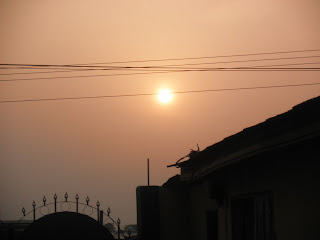 |
| Sunset over the courtyard wall |
 |
| Looking out of the kitchen to the courtyard |
 |
| Rita, "The Queen," doing laundry and watching over her castle |
 |
| Rita with her goddaughter |
My room is about 12' by 12' with an ajoining shower (no running water, just bucket baths). The room is furnished with a full-sized bed, a side table, desk, and a place to hang or store my clothes. When there is electricity, I make use of an overhead light and a fan.
 |
| My bed and mosquito net |
 |
| The adjacent shower |
 |
| The living room |
There is a caretaker that lives here named Joseph. I'm not sure what he does or is supposed to do but he so sweet to me. He is constantly buying presents for me: vitamilk, apples, juices, etc. Once he took me out for a juice. I plan to get him back right before I leave but he has protested so much that for the sake of his masculinity, I don't push the issue for now. Bottom line: I might be the biggest diva within a 15 mile radius. I told Tony that he treats me like a princess, to which he replied in a thick Liberian accent, "More to come"--absolutely melted my heart. Tony is easily one of the nicest people I have ever met. He is quiet, loves to read and play sudoku and is never spotted without his red Obama baseball cap. Tony and I often sit on the porch and discuss politics: Charles Taylor, Obama, the civil unrest over the contested election in the Ivory Coast, and other events we hear about on BBC Africa.
 |
| Joseph, the "caretaker": |
 |
| Tony, the cook: |
The Trek to Accra:
Yesterday I'd told everyone (including the taxi driver we'd hired) that we were going to be running on WMT today and that anyone who arrived one minute after 9:00am was getting left behind--a policy that I wouldn't have enforced, but the threat proved effective. Around 8:10am, Roger and the Women Skills Training Center arrived. Morris arrived about half an hour later. The taxi driver arrived early too (around 8:45am) and we left not 5 minutes later.
We spent about three and a half hours in Accra, but I returned absolutely exhausted despite getting a good night's sleep. I even fell asleep in the taxi on the way back, which is quite a feat because of the constant jerking and stalling out of the beyond beat up stick-shift taxi surrounded by drivers who honk more than they do in NYC. The marketplace in Accra was packed with people. It's kind of disorienting because the content of the shops are identifiable until you are right in front of them and even then there might not be any one unified theme. Being white, I draw extra attention; people are constantly waving things in my face, grabbing at me, or calling me into their shops. Morris and I reached the bookstore successfully, and we spent about $350 on school books, notebooks, arts and other supplies while Rogers and the Women's Center rep. went off to purchase fabric.
A Misunderstanding:
While in Accra, there was a situation in which I felt like a friend was pushing me into buying school books for his children. Between this incident and another in which I felt like I was not allowed the appropriate amount of control over my project, I felt slighted. I've been told that in Ghana it is common for people to tell you "You'll give me ___," or "Let's go have a juice" (read: "You'll buy me a juice") and that these questions function as questions to which it is your responsibility to say no.
Privilege and Power:
I was still plagued by the incident over the books for my friend's children. I was warring between two perspectives. On one hand, if Person A has more than Person B, Person B is not entitled to what belongs to Person A. More importantly though was the fact that being a "yes girl" or a pushover creates a power dynamic that is unpalatable to me and is ill-suited for a working relationship. On the other hand, if I had a one-time shot at getting school materials for my child that I couldn't afford, I might be more pushy than he was.
Similarly, when I think about how sellers try to rip me off by jacking up the prices because I'm an easy target, I can't really blame them. There's an extent to which I can't be ripped off. Even the elevated prices are less than what I would pay for the same products in the United States. However unsettling their attempts to rip me off, I can't begrudge the sellers for their actions. In this the usual power structure has been turned on its head to the extent that I am ignorant of the market prices and am thus easily fooled. The power structure cannot be upset to the extent that I can afford to pay their elevated prices.
To a large extent, poverty is not something you bring upon yourself but something that is brought upon you. We are all born into a global caste system. The quest for wealth is a zero-sum game in which some win but most lose. There are structures of power that serve to create and maintain the radical inequality that results in some people building a third house while many, many, many, many more are dying of hunger. A man can be proud of his hard work that earned him his fortune while realizing that the system of globalized capitalism privileges the hard work of some over others. The systems that arbitrarily privilege some over others inflict what many writers and theorists call "structural violence" on an undeserving people.
I benefit from these structures of power everyday: I am getting an education at an elite liberal arts college; I don't have to be concerned that any of my basic needs will not be met; and so on and so on ad infinitum. In fact, it was radical economic inequality that afforded me the opportunity to witness radical economic inequality here in Aboansan & Buduburam in the first place. I experienced a lot of "rich girl guilt" from the second I signed up for this trip. This guilt was the catalyst for my responsible giving fundraising project.
"Voluntourism":
I've read a lot about both voluntourism, both good and bad. It gets a bad reputation to the extent that it promotes the whole "whites in shining armor mentality." The "whites in shining armor mentality" is the idea that poor, "backwards" colored people need "progressive" white people to come and save them from their plight...and that they can do so in a should period of time. Many critics argue that this is just another insideous example of Western imperialism and Western arrogance. That's true in part but it ignores that voluntourism is in many ways responsible tourism. I could come here on vacation, make games out of cultural customs, and maybe even go on one of those twisted poverty tours, in which poor colored people are rendered animals as tour guides take paying customers into vilages to see the ways that a "strange and backwards people" live. Alternatively, I could be committing my time and money to a cause, a cause that I plan on working for at least through the spring semester. I'm happy to do it, and I've formed connections with some wonderful people.
Every single member of the PCO staff is owed money for their salaries that has not been paid for a couple months now. Mary, the school teacher in the village working to put herself through school; Morris, struggling to put his children through school; Wilfred, Rogers, all of them working tirelessly to help similarly situated people without pay. I'm grateful to have the opportunity to work to help to enable the incredible work they are doing for their community.
 |
| Mary |
 |
| Morris |
 |
| Wilfred |
 |
| Rogers |
I'm also very excited about the volunteer trip I'll be taking to Buenos Aires over Spring Break and the opportunity it will give me to see a dear friend.
****************
If anyone would like to donate to the Aboansan village school, I am starting a new "chipin" to facilitate hassle-free donating. If anyone has things that they are not using that could be of use to PCO or the village children such as:
clothes for children ages 10 and under
books appropriate for children 1st grade or below
a digital camera, laptop, or printer
OR
has any ideas about how to better help PCO via fundraising ideas or other means, please contact me at madeleinebrumley@gmail.com


